

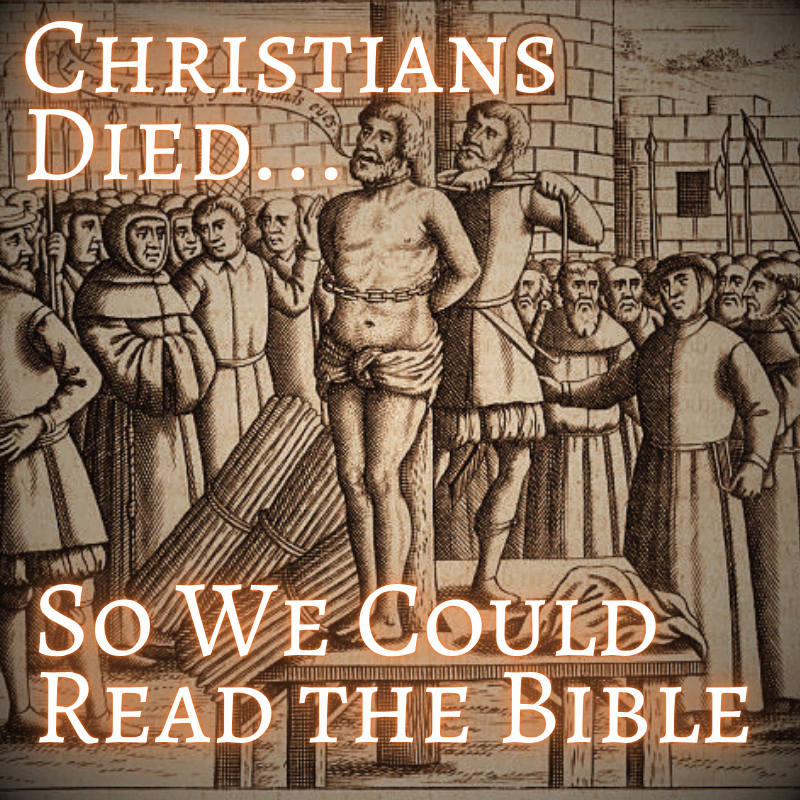
There have been extraordinary faithful Christians throughout history who have given their lives for the faith. Two people who come to mind are John Wycliff and William Tyndale. During their time, the Bible was practically under lock and key to the average man, being printed only in Latin and primarily read aloud in Latin. Both Wycliff and Tyndale, however, believed that the Bible ought to be accessible to all English people, and so they translated the New Testament into English. This endeavor, along with their attacks on some of Catholicism’s beliefs and practices, eventually led to their persecution, and for Tyndale, martyrdom. Although it may be difficult to grasp today with the freedoms we have, these Christians gave their lives (for Tyndale, literally) so that we could read the Bible.
Tyndale was born in England (in the late 1400s) and was a scholar of the highest degree, eventually teaching at the University of Cambridge. His first translation of the Bible was published in 1525, but not before being persecuted by the church in England for his work. To escape the deleterious church, he fled to Germany where he was able to complete the translation with substantial financial support. Eventually, Tyndale’s pursuers caught up to him. He was arrested in Belgium and led off to be executed by strangulation and being burned at the stake. His crime? The heresy of translating the Bible into English so any person could read it.
John Wycliff, in contrast to Tyndale, avoided martyrdom, but his life was not without its persecutions. His trouble was compounded by his outspoken disagreements with some of the church’s beliefs like transubstantiation. When he decided to translate the Bible into English, he did himself no favors. Through the course of his life, he was ridiculed, banished from Oxford (where he taught), and always under pressure to discontinue his efforts, often working underground. In fact, many of Wycliff’s followers were pressured by Catholic bishops to recant, and many were in fact martyred.
Many other Christians throughout history followed similar paths to that of Tyndale and Wycliffe. We could mention Johannes Gutenberg, the inventor of the printing press. Although he was not martyred, he suffered through many trials and tribulations (effectively having his inventions stolen from him) to print the first complete Bible in English. Guttenberg’s printing press was certainly a divine gift to the world that came at a high cost for Gutenberg, including his bones being exhumed 40 years after his death and burned, being declared a heretic.
We could provide many more examples of our Christian predecessors who were either martyred or persecuted for giving us the Bible in our own language. It still happens today in some countries of the world. Christians have given their lives so that we could read the Bible. I am convinced that God himself providentially worked through these men to make this a reality for us. But how many of us really take advantage of this fact? How many days go by that our Bibles sit on the shelf collecting dust? How many times do we justify ourselves, saying, “I’m not a reader” or “I don’t like to read?” Men gave their lives so that we could read the Bible, and yet we pay little to no attention to reading it.
That Christians, especially in America and the West in general, do not read their Bible is supported by numerous studies. Do a quick google of the studies completed by Pew Research and Barna and this becomes clearly evident. Moreover, the average American just does not read. Again, this is supported by numerous studies. A quick google reveals this as well.
The Bible itself would certainly indict us for paying so little attention to reading God’s Word. It commands us to read Scripture in worship: “Until I come, give attention to the public reading of Scripture, to exhortation and teaching” (1 Tim 4:13; NASB). It reminds us that Scripture is useful for all of life: “All Scripture is inspired by God and profitable for teaching, for reproof, for correction, for training in righteousness” (2 Tim 3:16). If we are not reading it, then how can it be useful for these things? Jesus indicted the Pharisees for not reading properly and understanding Scripture, proclaiming, “You are mistaken, not understanding the Scriptures nor the power of God” (Matt 22:29). Jesus also stated, “Have you not read this Scripture?” (Mark 12:10). And how can we forget such declarations from Jesus like, “Sanctify them in the truth; Your word is truth”? If God’s Word is truth, then we ought to be reading it.
In America, overall, we are blessed to be a society that, at least historically, values literacy. Most Americans know how to read to some degree. Surely, we excel at different degrees; some struggle with reading and others are very proficient. But the studies show that we do not read at all, or very little, especially Scripture. But men of old died so that we could read the Bible. They fought to print Scripture into the languages we speak. They did the unthinkable at their time: they unchained the Scriptures from its slavery to the clergy. So the next time you pick up your phone or the TV remote, remind yourself, “Christians died so I could read the Bible. Did I read it today?” If not, unplug from the screen. Read the Scriptures that were unlocked for you by those who suffered, bled, and died so you could read them.
Pastor Pete